BOTH SIDES OF THE LOOP, SCENE BY SCENE
Every screen below is a real frame from the live product demos — the donor app, the nonprofit dashboard, and the onboarding wizard — stitched into one story: how a dollar becomes proof, and proof becomes the next dollar.
PLAY AUTO-ADVANCES SCENE BY SCENE · SCROLL ANY TIME TO TAKE OVER
THE TRANSPARENCY LOOP
ONE GIFT, SIX CONNECTED EVENTS — THIS IS THE WHOLE PRODUCT ON ONE DIAGRAM
THE DONOR — SEEING IS BELIEVING
Research says one thing drives giving-platform trust above all: information quality (β = 0.626). Act I shows how OGOGO turns that finding into screens.
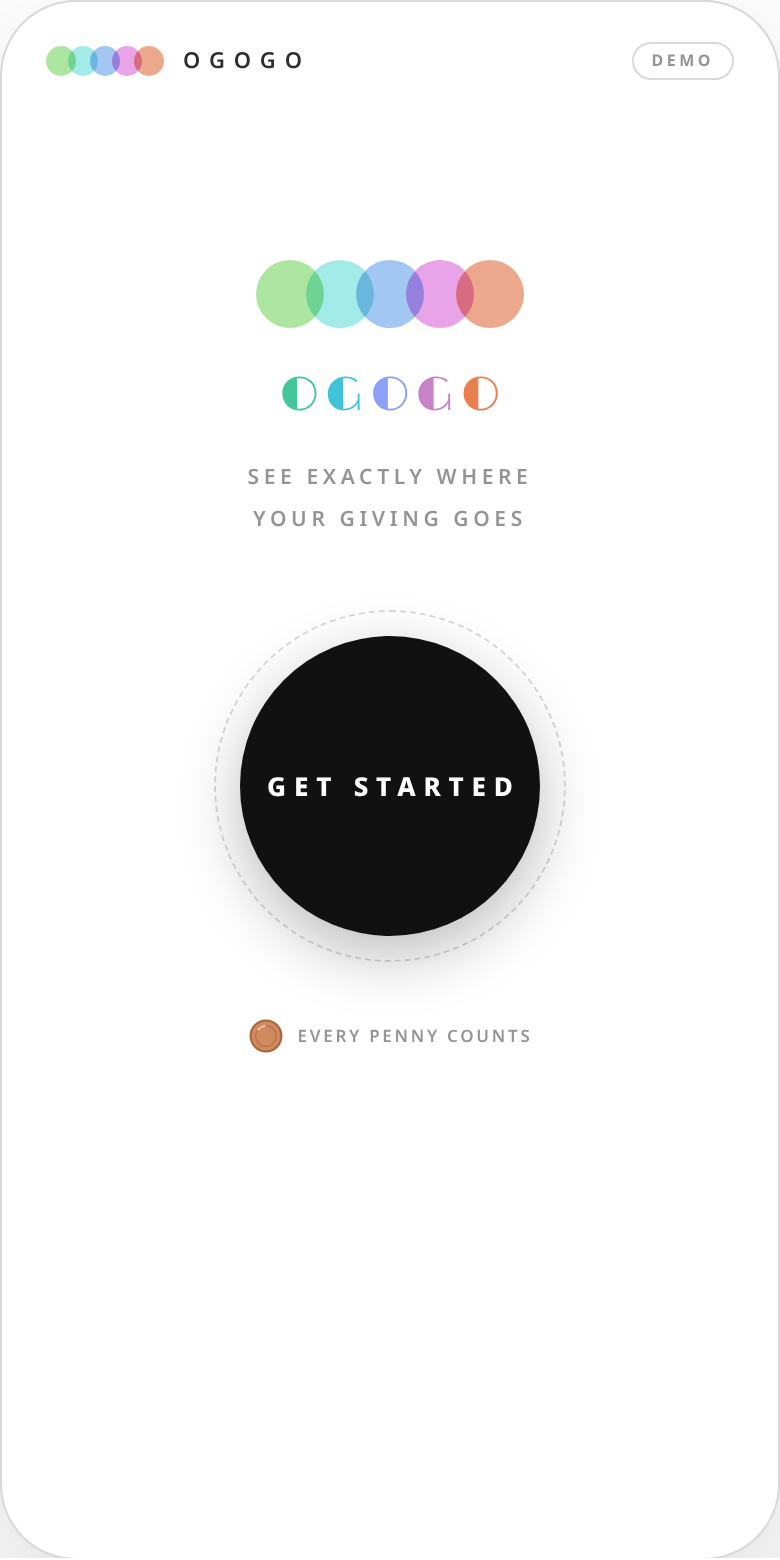
One promise on screen one
No mission-statement soup. The app opens with the entire value proposition in six words: see exactly where your giving goes.
Category positioning in one screen — every competitor opens with a donation form; OGOGO opens with visibility.
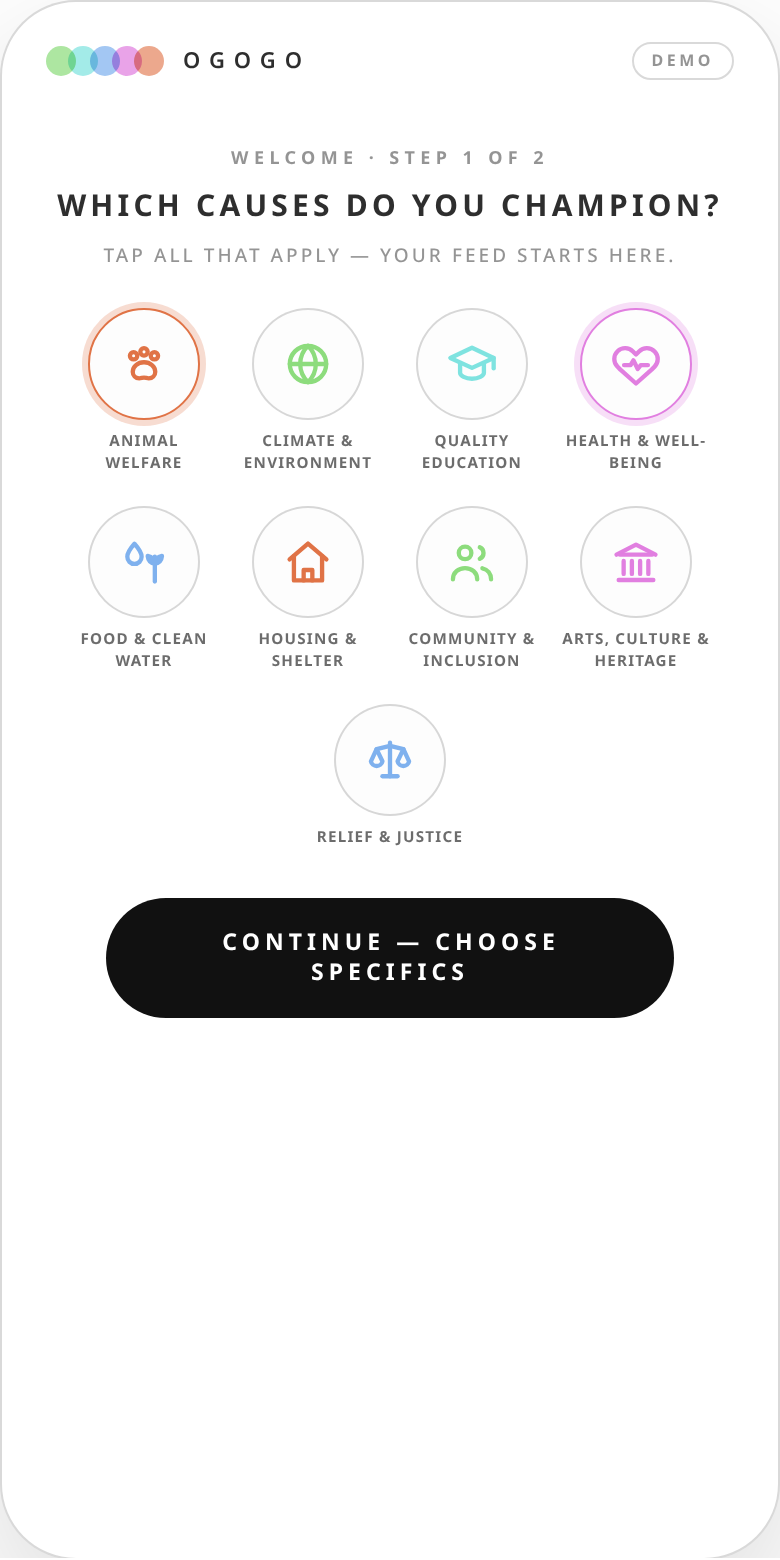
Champion causes, not charities
Donors pick the work they care about — animal welfare, education, food security — before they ever see an organization’s name. The feed is tuned from the first tap.
Identity-first onboarding: loyalty research says repeat giving is an identity outcome. OGOGO starts building that identity 10 seconds in.
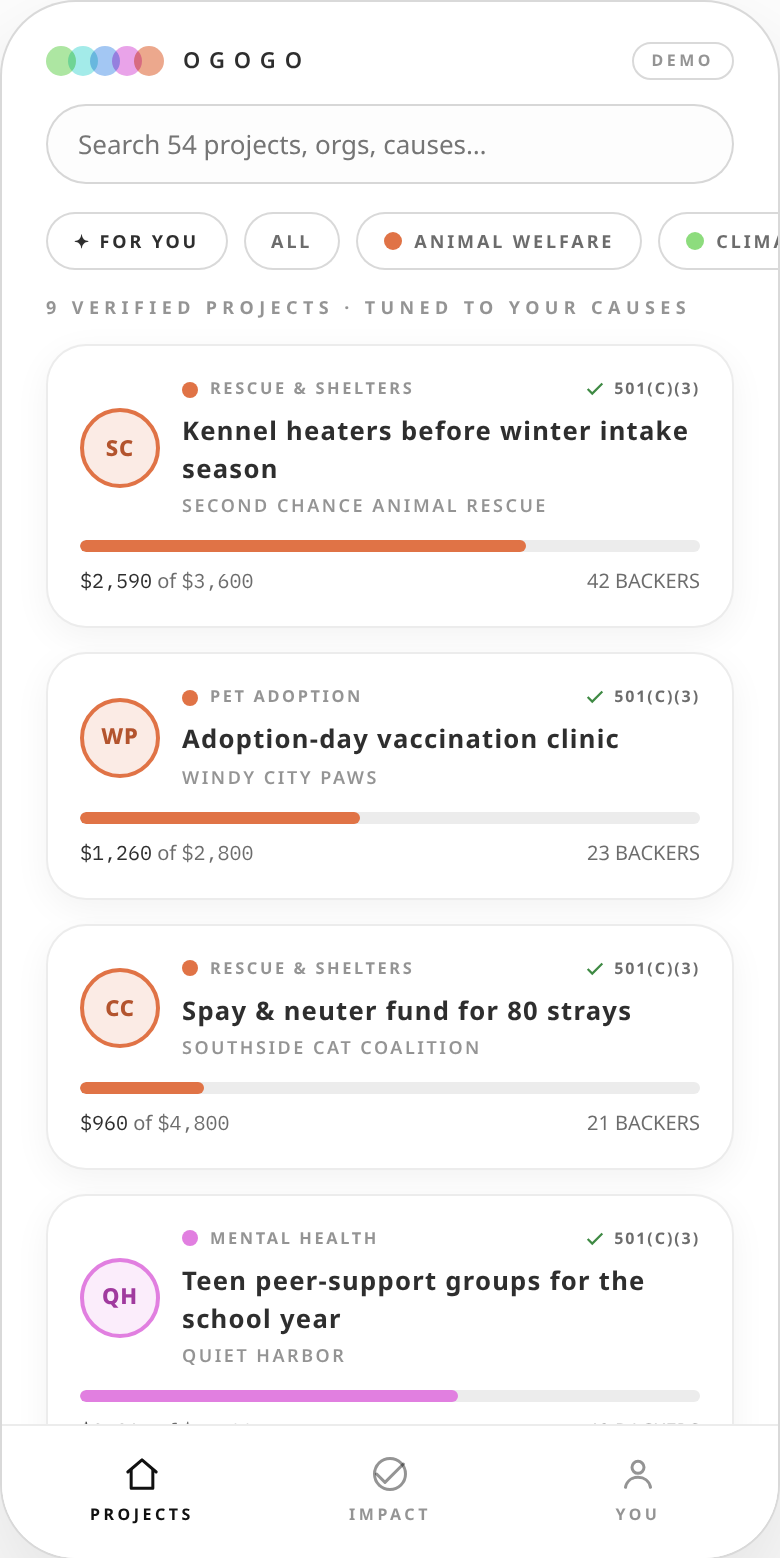
A feed of verified projects — not appeals
Every card is a specific, vetted project with a budget, a progress bar, and live backer counts. 54 sample projects across 9 causes in the demo.
Supply is curated, not crowdsourced — the ✓ 501(c)(3) tag on every row is the moat competitors skipped.
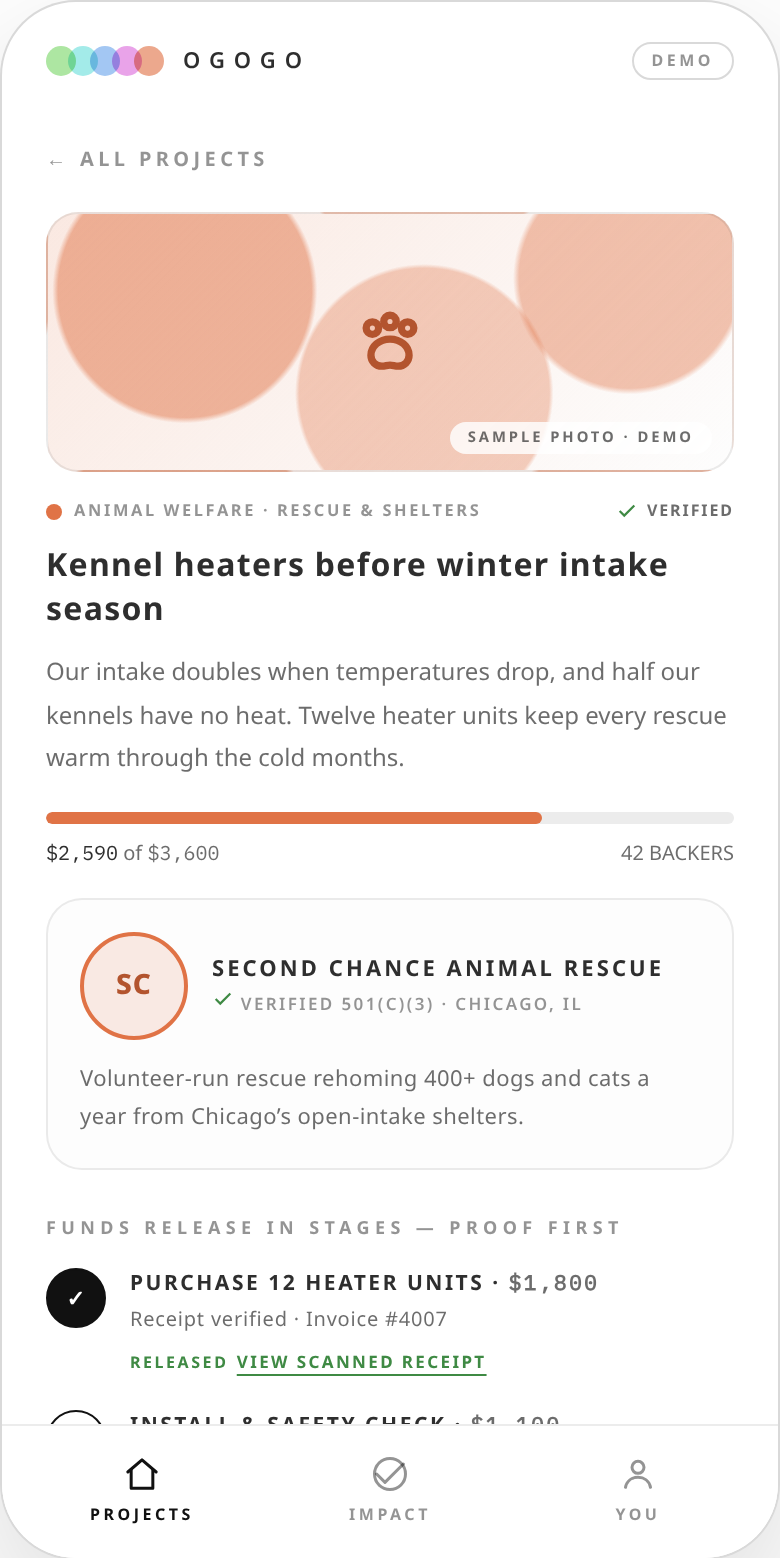
Stages, not black boxes
The project page shows exactly how funds release: stage by stage, each stage gated on proof. Released stages link to the actual scanned receipt.
This is the product answer to the sector’s 55-year-old open question — who checks what happens to the money? Here, everyone can.
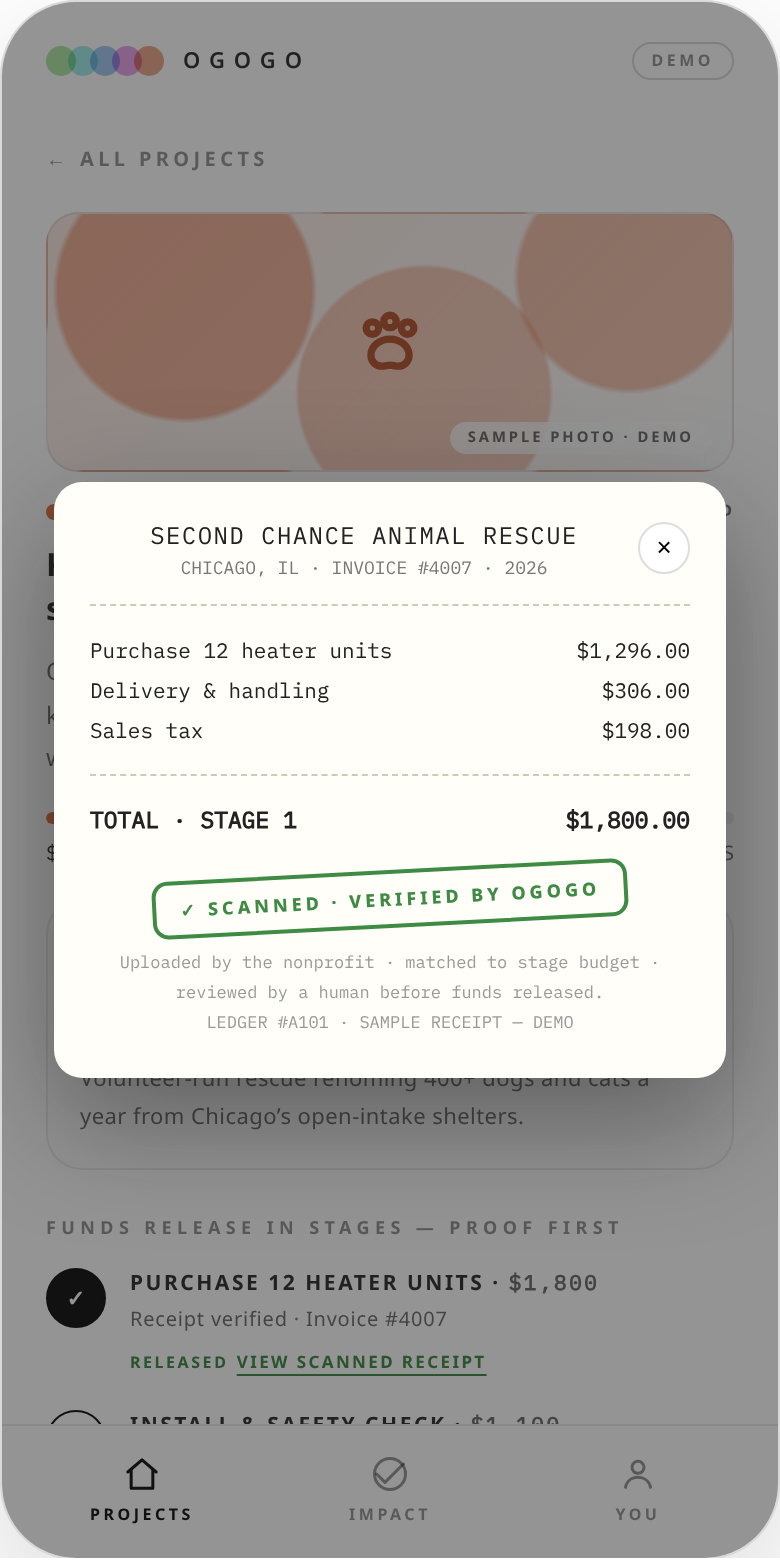
The receipt is the interface
Tap a released stage and the scanned, line-item receipt opens — uploaded by the nonprofit, matched to the stage budget, reviewed by a human before a dollar moved.
Information quality is the #1 trust driver (β = 0.626). No competitor shows donors a scanned receipt. This screen is the thesis.
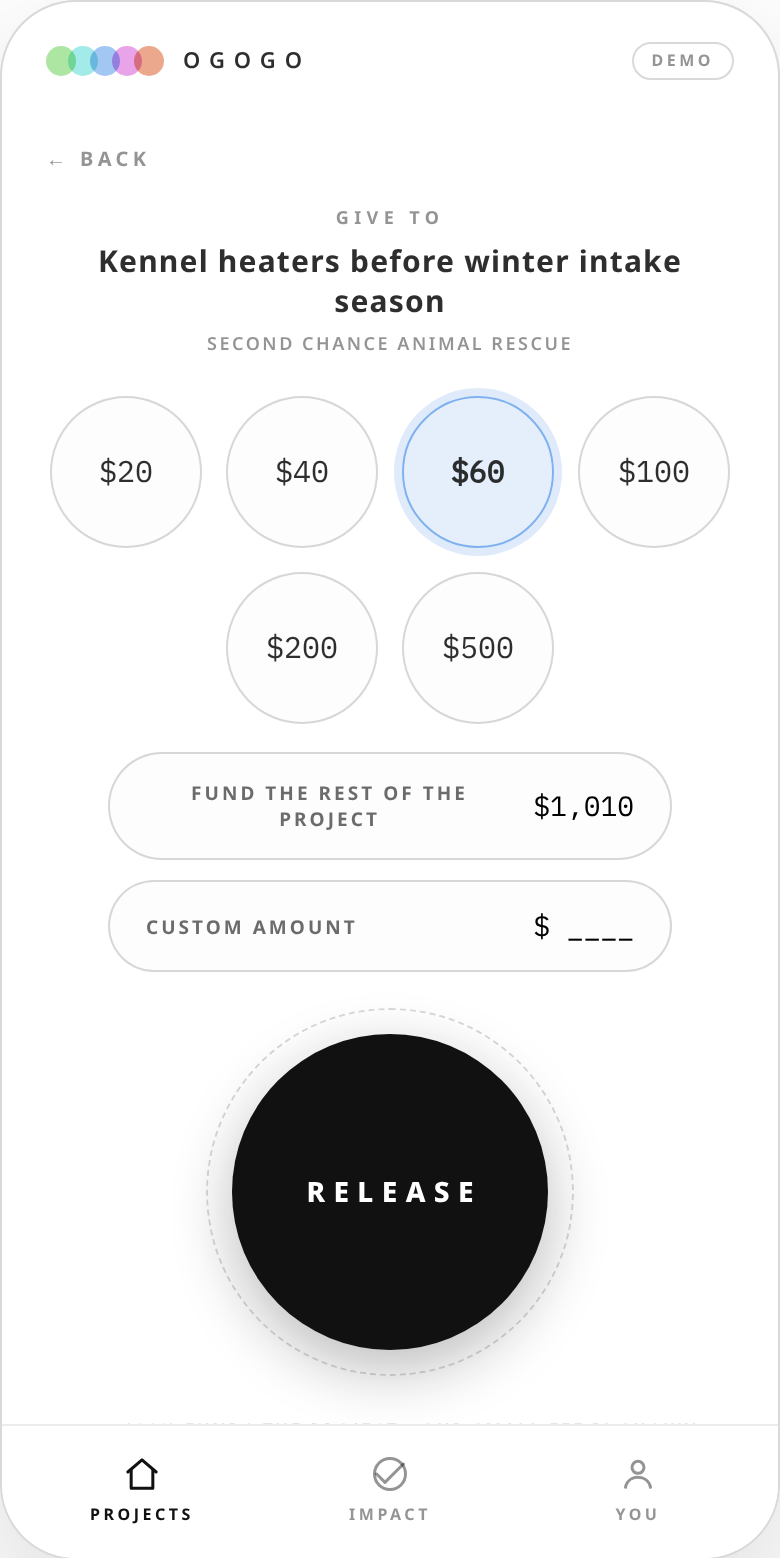
An ask ladder built from the literature
Six preset bubbles ($20–$500), a “fund the rest of the project” anchor, and a custom line. The fee line sits right under the button: 100% funds the project, our small fee always shown.
Defaults move ~12% of the gift distribution, familiar denominations add ~7%, and a high anchor (0.638 upper-anchor effect) lifts the median from $25 to $50. This screen is engineered revenue.
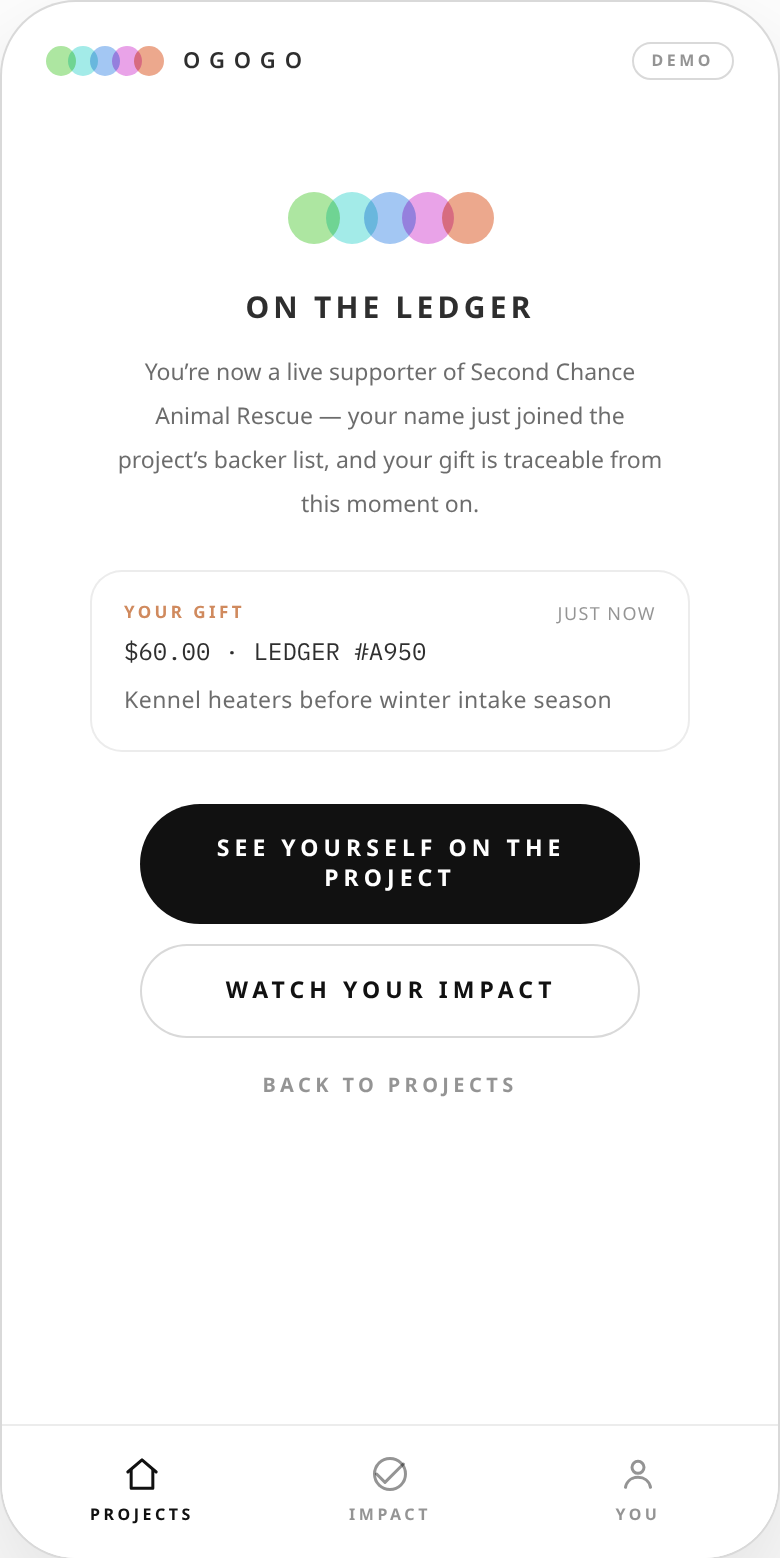
Not a thank-you — a ledger entry
The gift lands with a ledger number, the donor joins the project’s public backer list, and the money is traceable from this second on.
Every gift creates an auditable record — the data asset (gift → stage → receipt → outcome) that no incumbent owns.
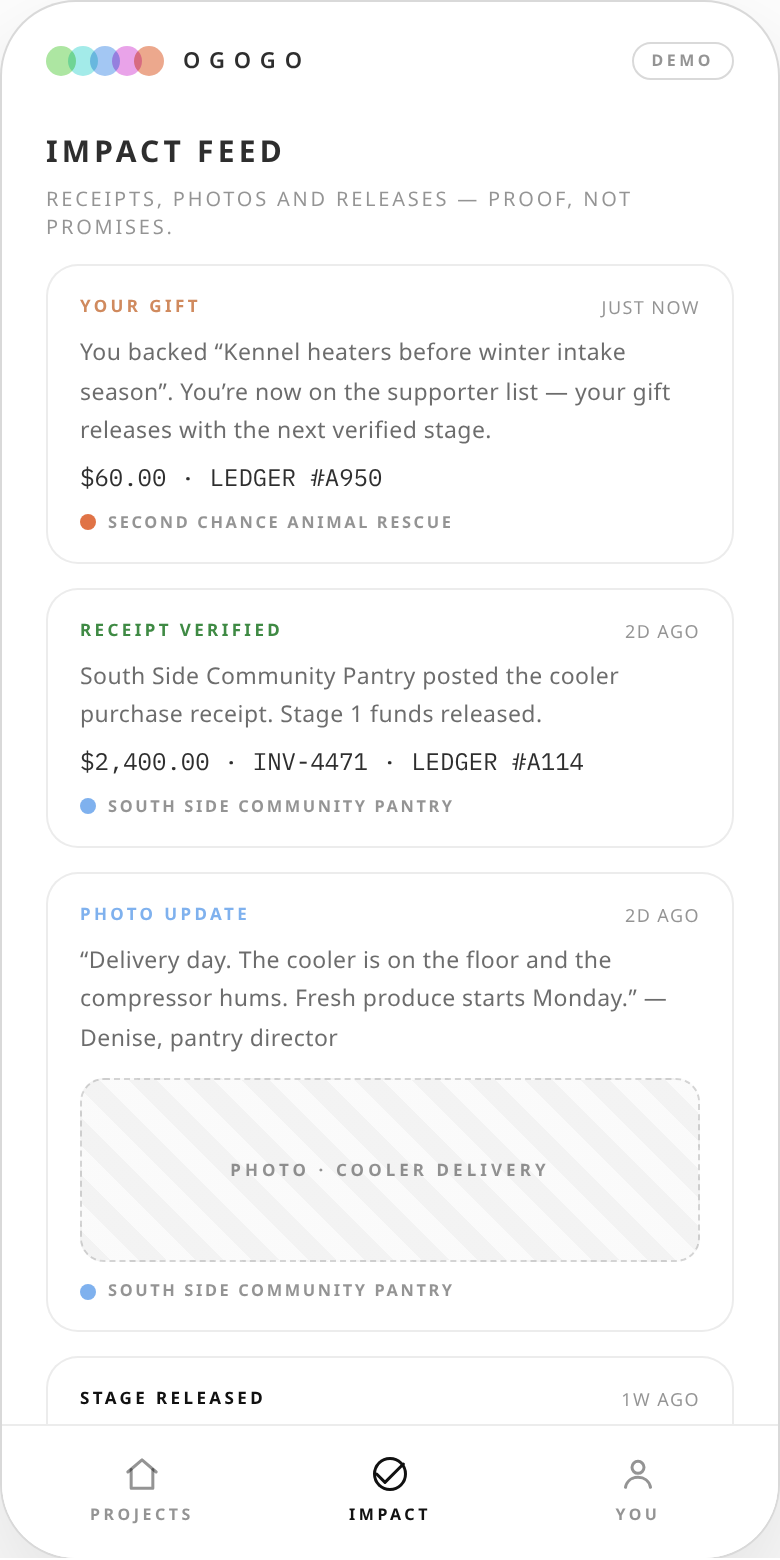
Proof, not promises, in the feed
Verified receipts, delivery-day photos, released stages — a feed of things that happened, each tied to the donor’s own gifts.
Retention is the whole economics: past giving explains ΔR² = .592 of future giving. This feed is the retention machine — and the reason donor LTV compounds.
WHAT HAPPENS UNDER THE RELEASE BUTTON
THE GIFT NEVER GOES INTO A GENERAL FUND — IT LANDS IN A STAGED PROJECT LEDGER
THE NONPROFIT — PROOF MADE EASY
95% of nonprofits score 2.0–2.4 / 5 on reporting maturity. OGOGO doesn’t ask them to get better at paperwork — it makes proof a two-minute phone-camera job.
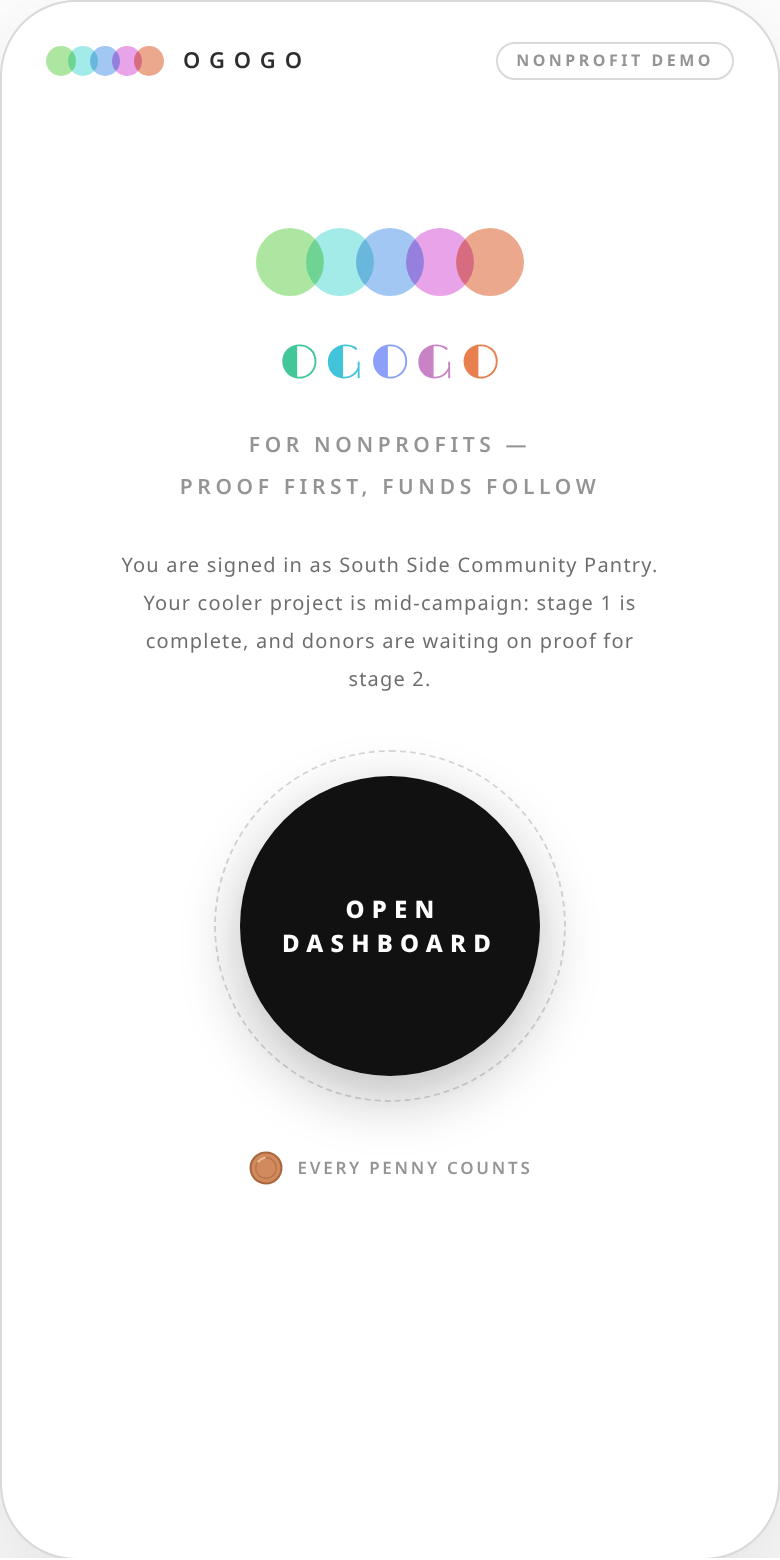
The other side of the same loop
The nonprofit signs into the same system the donor watches — one dataset, two views. The rule is on the door: proof first, funds follow.
Two-sided platform, one source of truth — no reconciliation layer, no reporting after-the-fact. The workflow is the report.
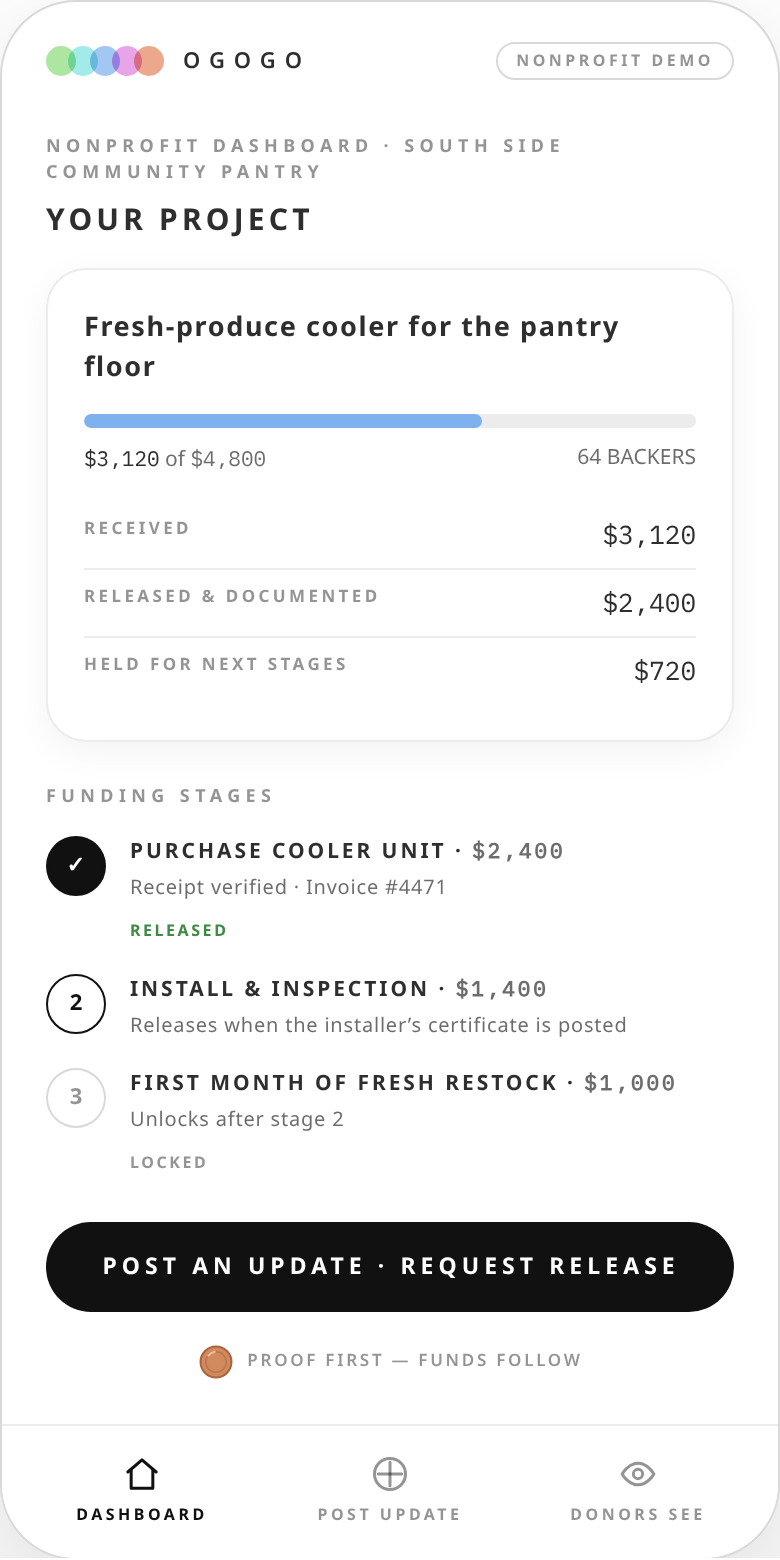
One project, three numbers
Received, released & documented, held for next stage. The nonprofit always knows exactly what unlocks the next dollar — and so does every donor.
Staged release aligns incentives without policing: the nonprofit wants to post proof, because proof is money.
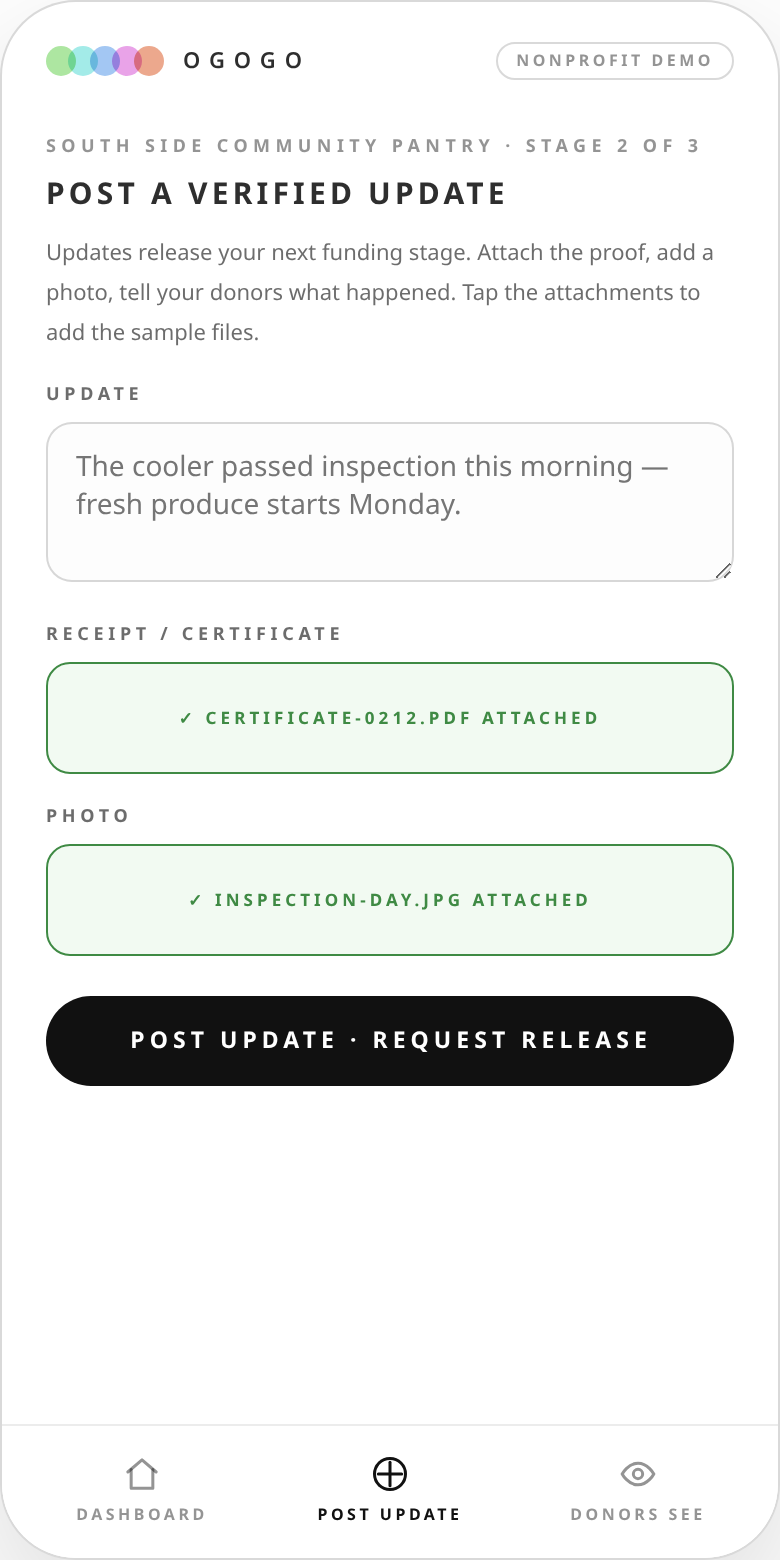
Two minutes with a phone camera
An update is three fields: what happened, the receipt or certificate, a photo. Receipts are required; the button stays locked until proof is attached.
Built for the ~900K U.S. nonprofits under $250K revenue — organizations with no grant writer and no ops team. The floor is a phone.
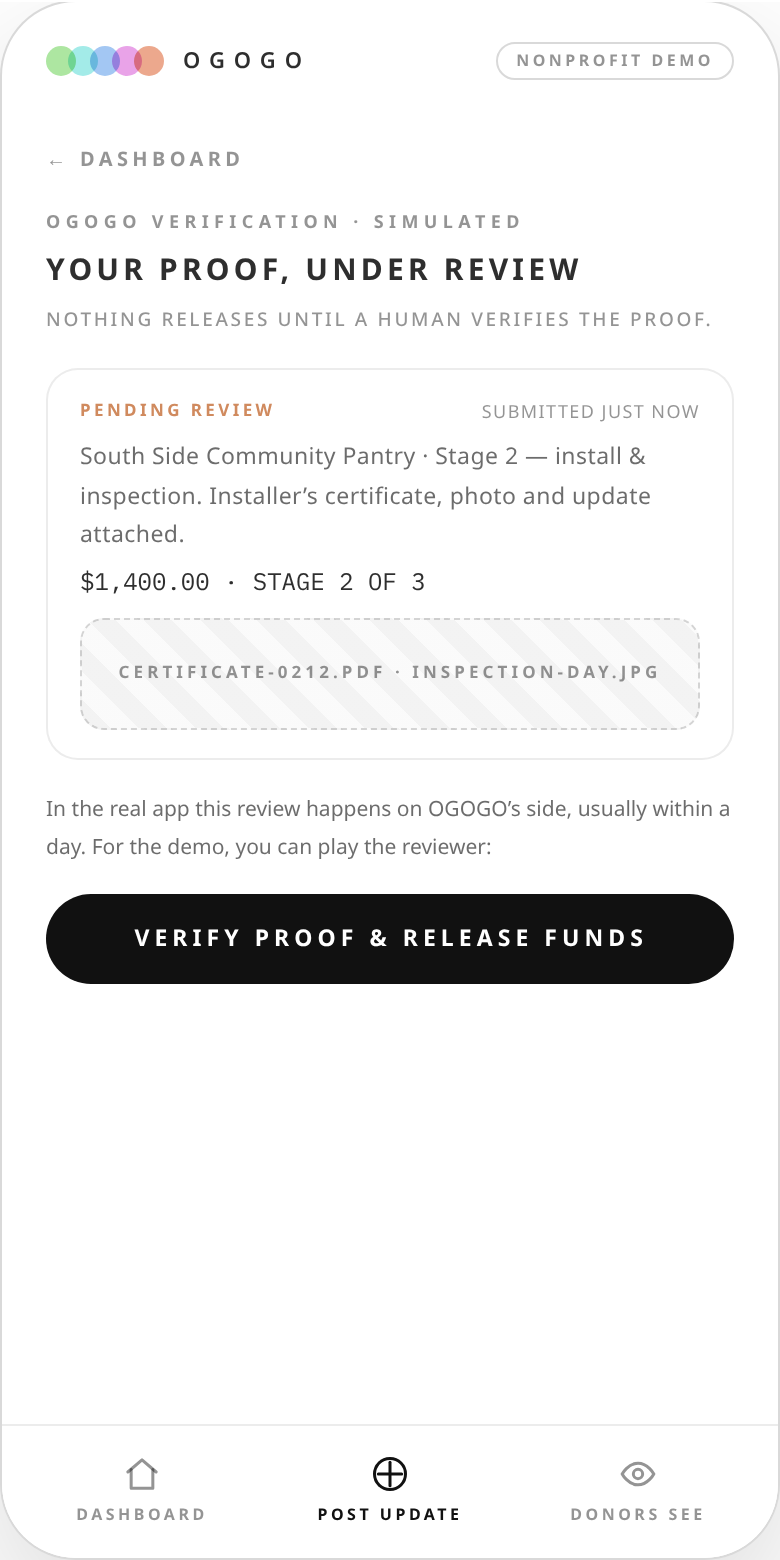
A human gate, not an upload folder
Submitted proof queues for OGOGO review: documentation matched to stage budget before any release. Nothing publishes, and nothing moves, unverified.
Verification is the defensible service layer — the thing watchdogs do annually and platforms don’t do at all, done per-stage.
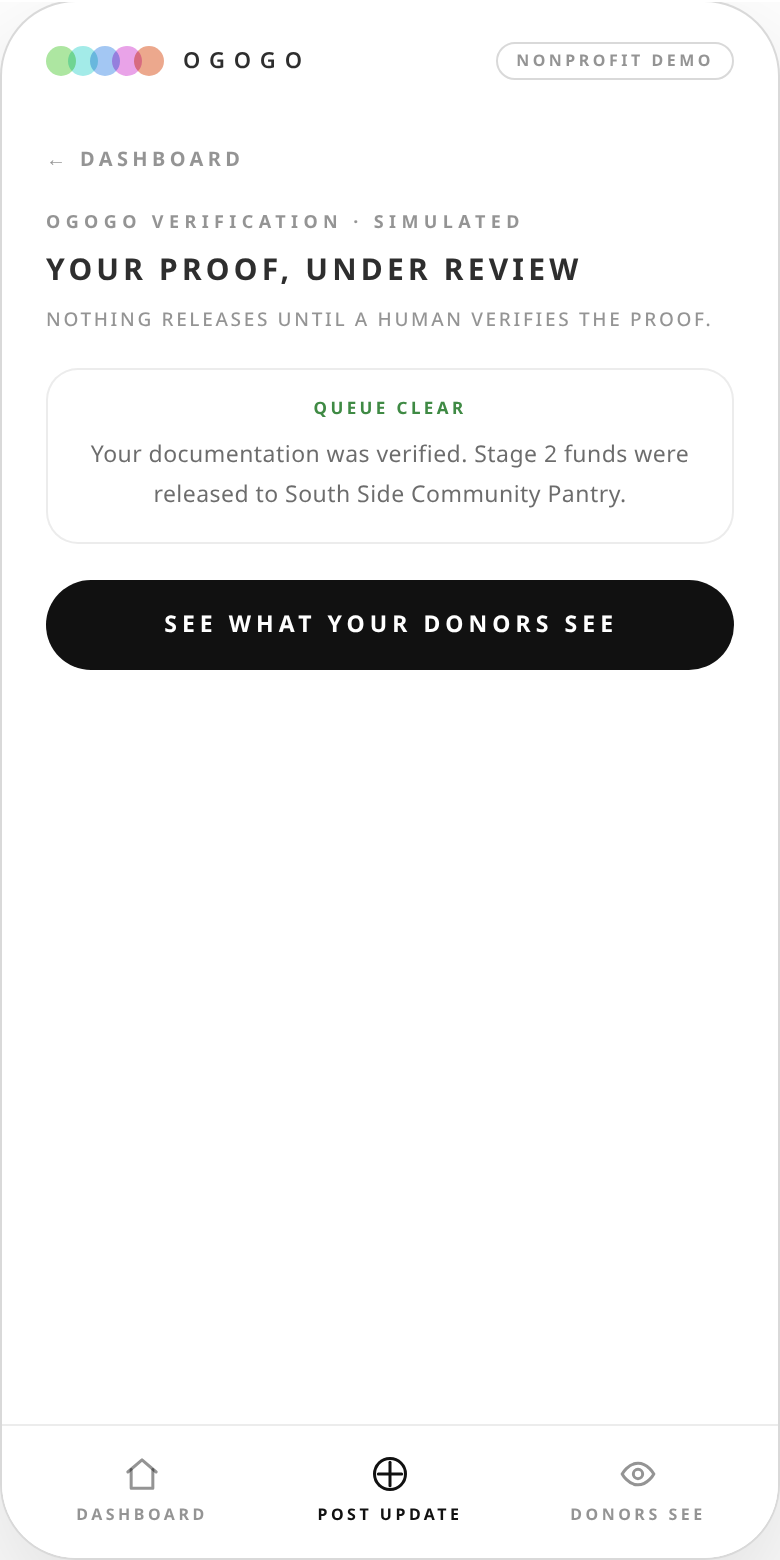
Verified → released → visible
The moment proof clears review, stage 2 funds release — and the same event posts simultaneously to every backer’s impact feed.
One verification event serves both sides at once — the marginal cost of donor trust rounds to zero.
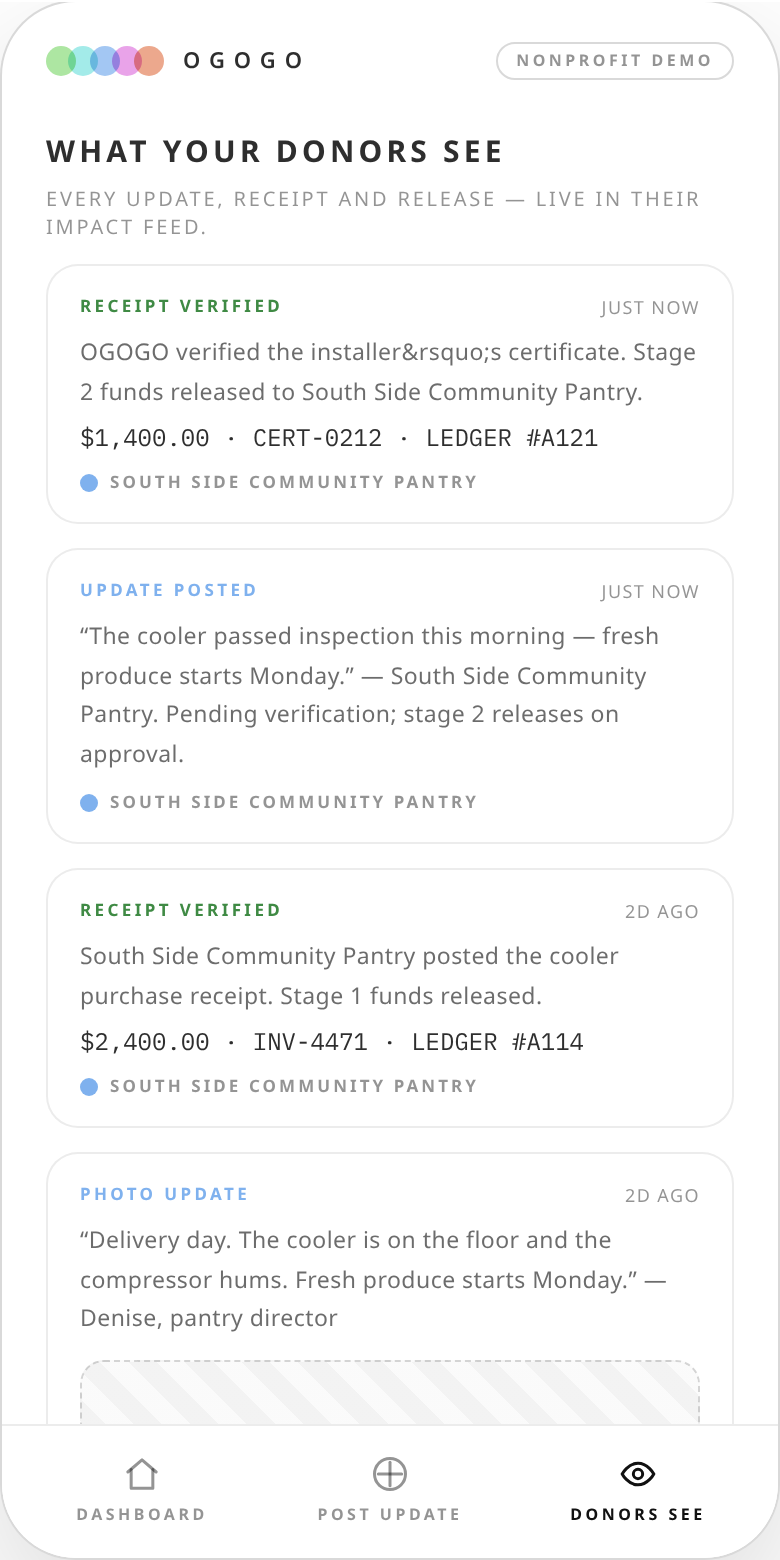
“See what your donors see”
The dashboard’s last tab is the donor’s feed. Every update, receipt, and release the nonprofit posts is exactly what supporters watch land — no gap between the story told and the story shown.
This mirror is the retention flywheel: verified updates are the events that bring 1-in-10 viewers back to give again.
THE VERIFICATION PIPELINE
EVERY STAGE RELEASE PASSES THE SAME FIVE CHECKS — THIS IS THE SERVICE OGOGO SELLS
ONBOARDING — SUPPLY AT SCALE
The pipeline that fills the feed: a 15-minute guided application a first-time founder can finish — with a realistic budget drafted by the app, not by a grant writer.
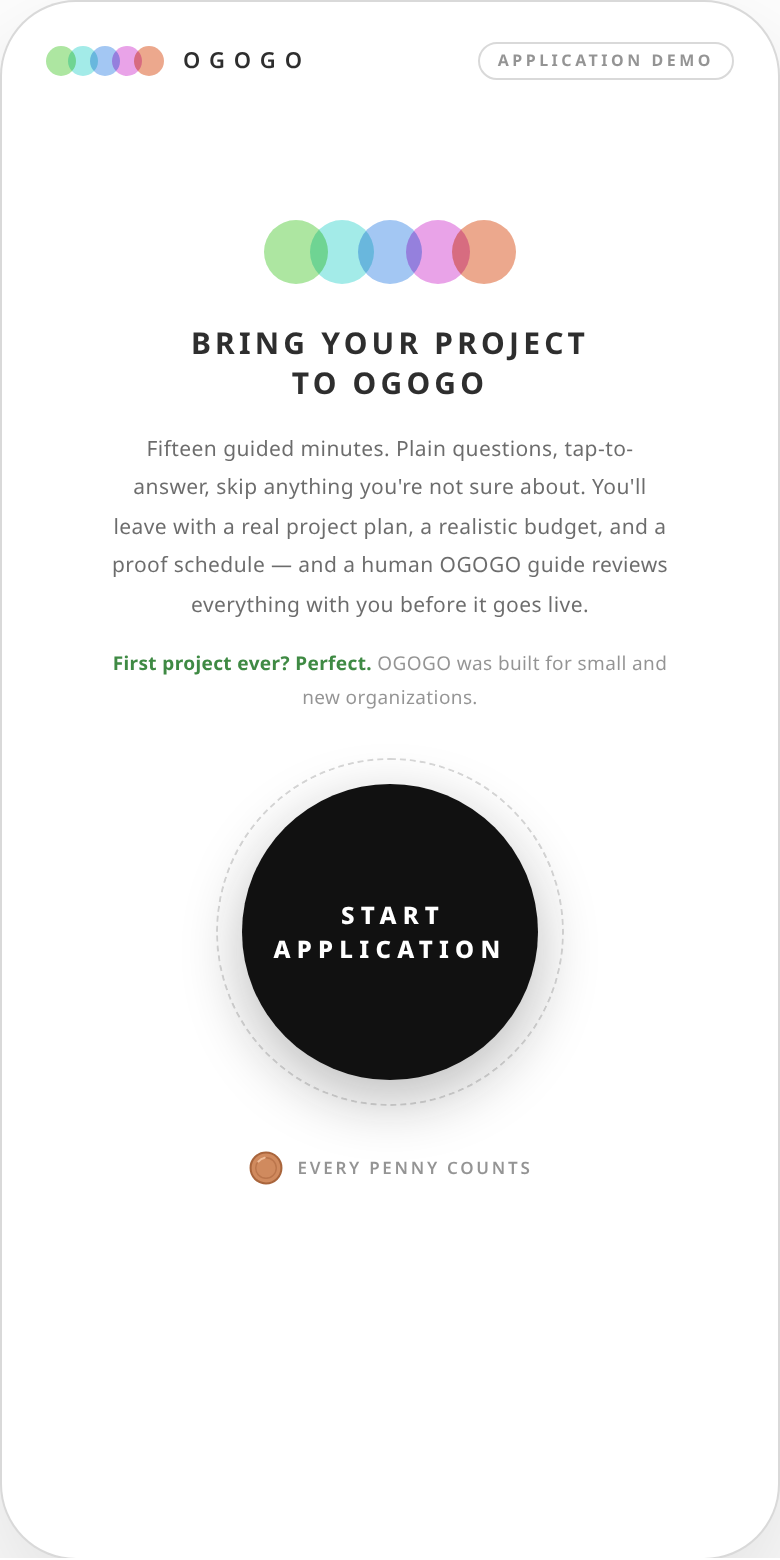
Fifteen minutes, no grant-speak
Plain questions, tap-to-answer, skip anything unsure. First project ever is a valid answer — the wizard was designed for young and non-technical founders.
Onboarding friction is the supply bottleneck for every vetted marketplace. This form is the CAC advantage on the supply side.
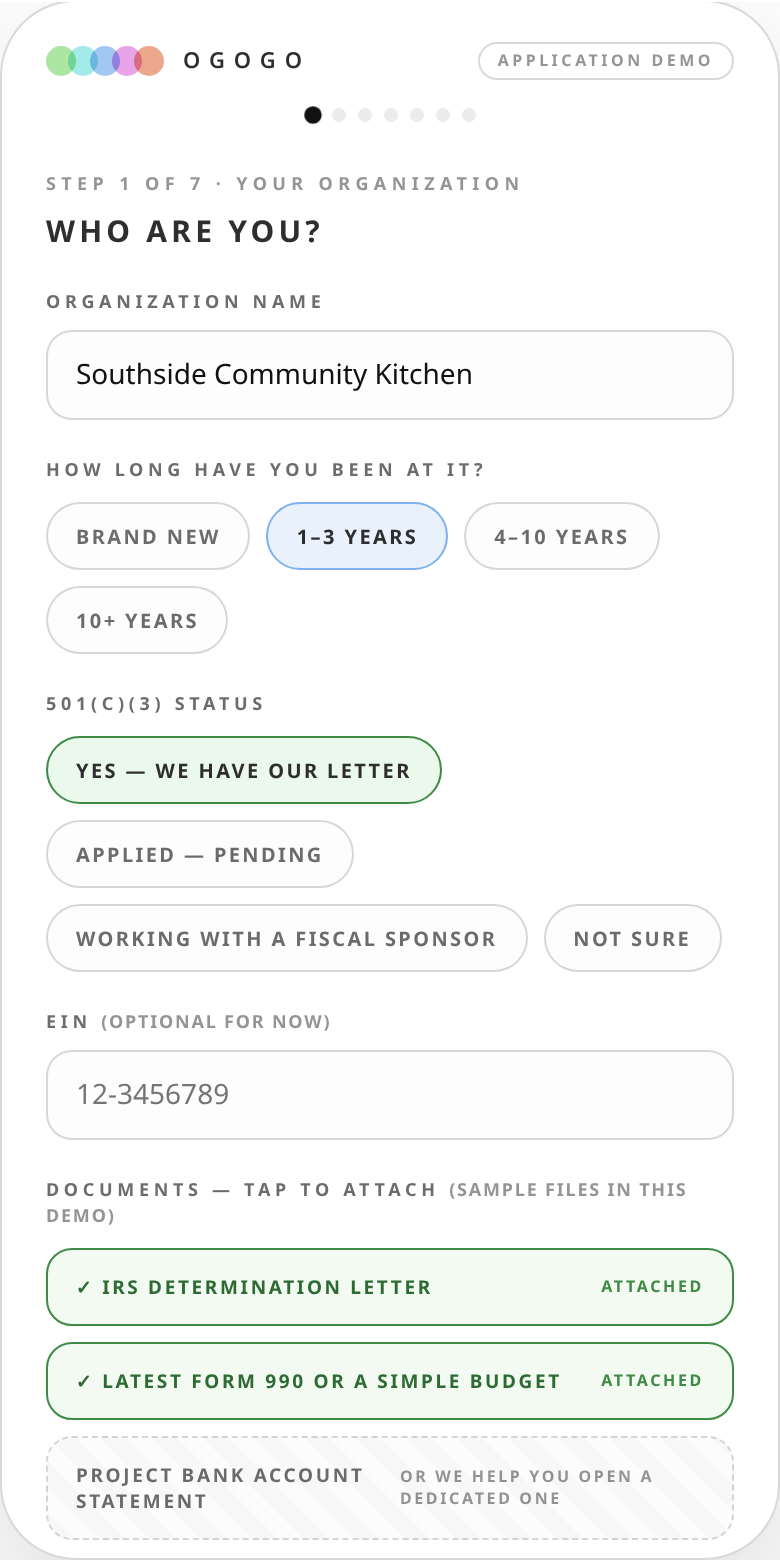
Vetting without intimidation
501(c)(3) status is a tap — and “not sure” is an accepted answer that routes to a guided call. Documents attach when you have them, not before you can apply.
Status is verified against IRS and state records — never self-reported. Trust is built at intake, cheaply.
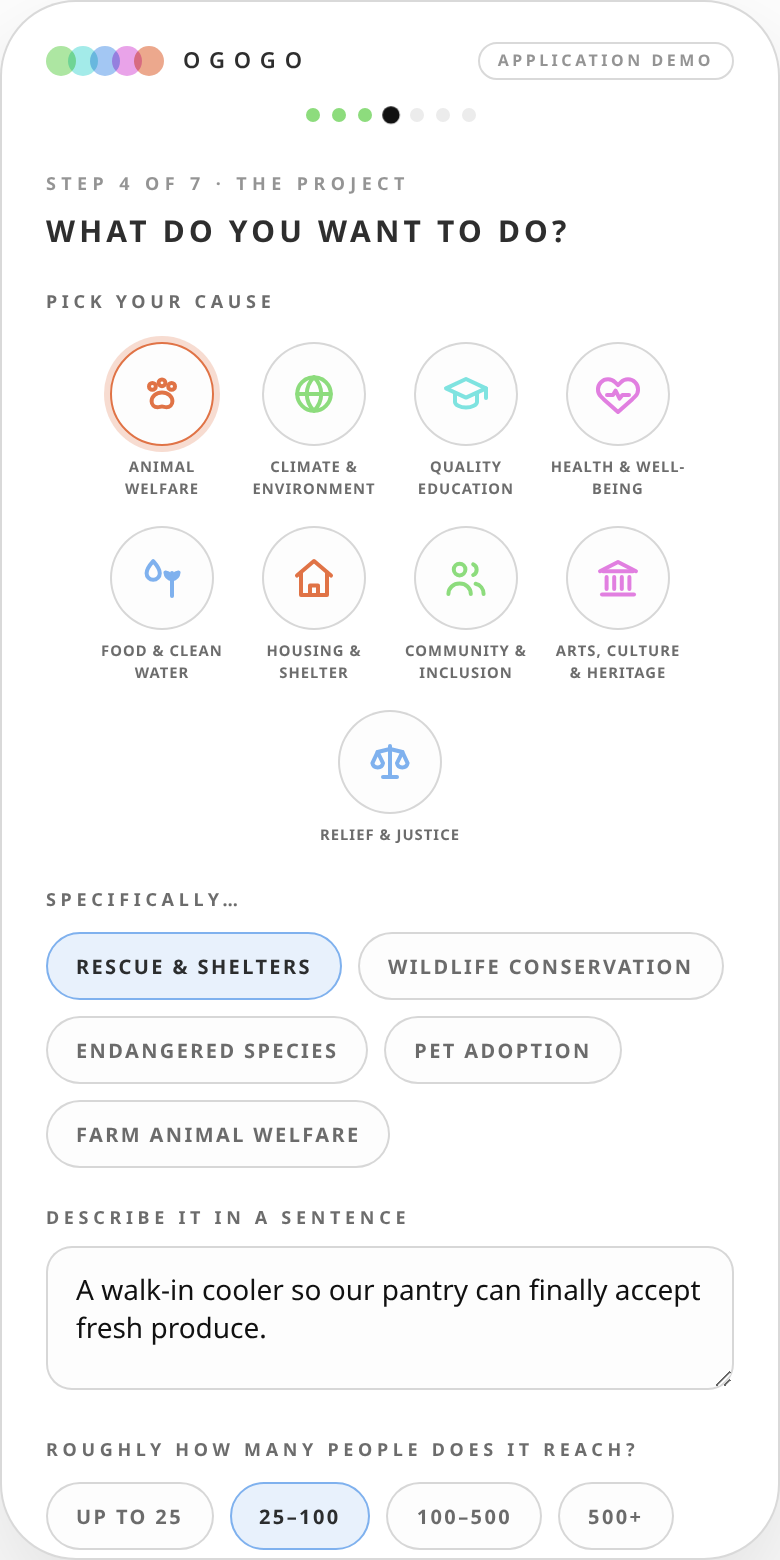
An idea in one sentence
Cause, one-sentence description, who it reaches, what’s already in hand. That’s all the algorithm needs to draft the project.
Structured intake means every project arrives as clean, comparable data — the corpus for underwriting and, later, ML-assisted vetting.
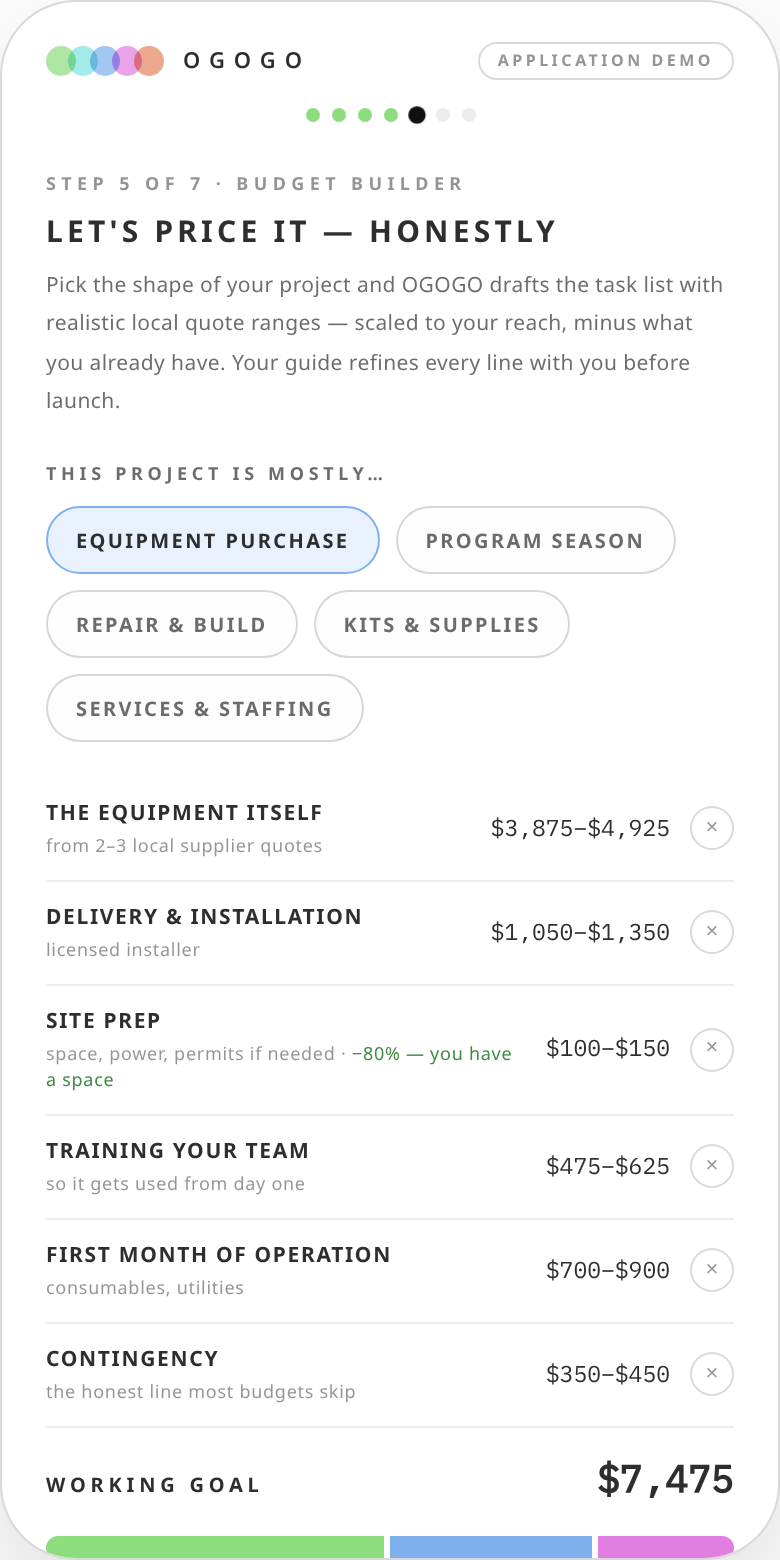
The app drafts the budget
From idea + scope + assets, OGOGO proposes a line-item budget with realistic local quote ranges — equipment, delivery, site prep, training, contingency. The founder edits; the guide firms up real quotes before launch.
Budget templates × people-reach factor × asset discounts — projects with no defined success indicators (the sector norm) leave this screen with stages, budgets, and pass/fail proof plans.
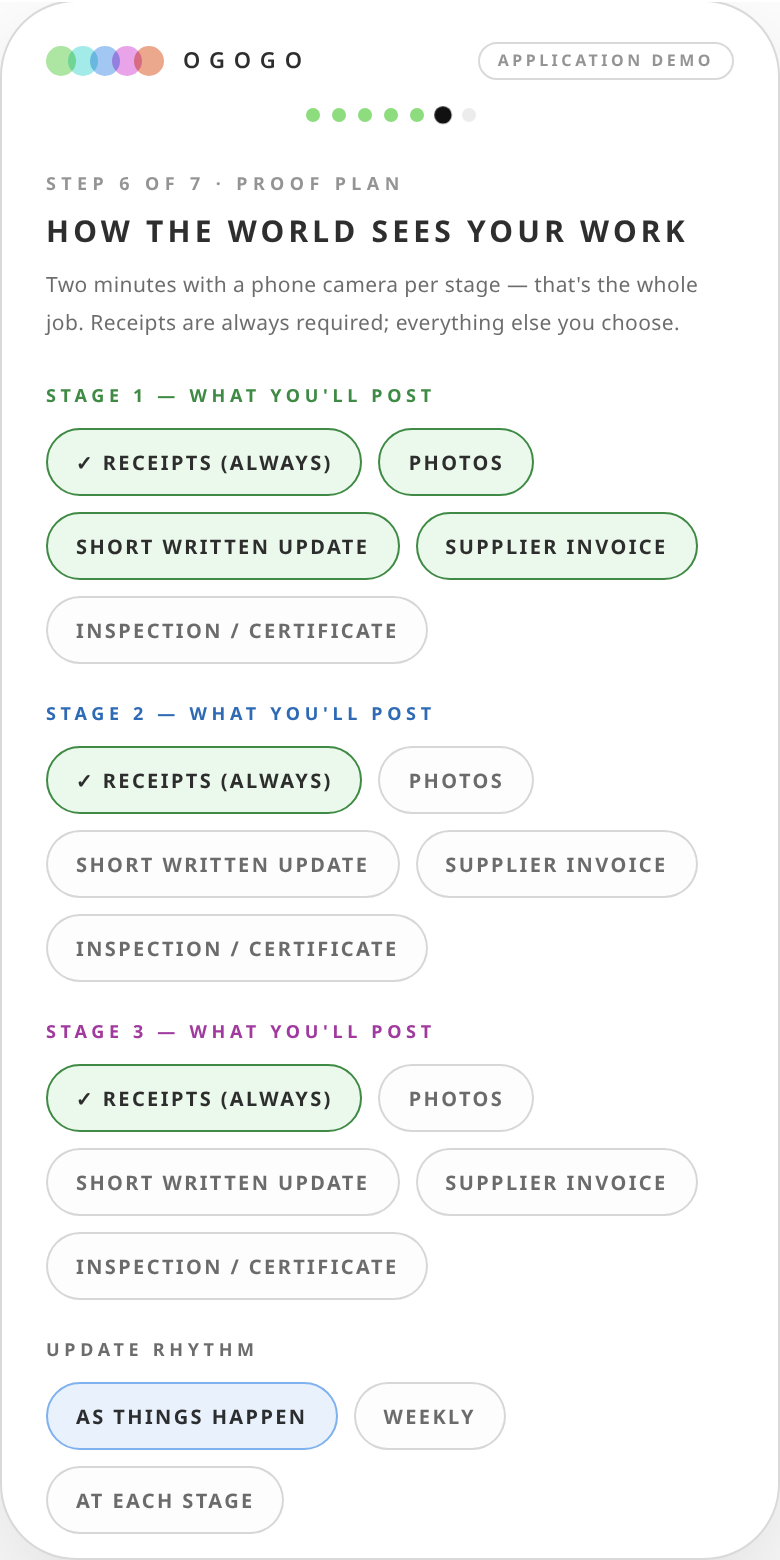
The proof schedule is set before launch
Per stage: receipts always, then the nonprofit chooses its rhythm — photos, short updates, supplier invoices, inspection certificates. Agreed upfront, so verification later is mechanical.
Pre-committed proof plans convert “reporting” from a favor into a contract term — the +0.6 maturity jump standardized methods deliver, productized.
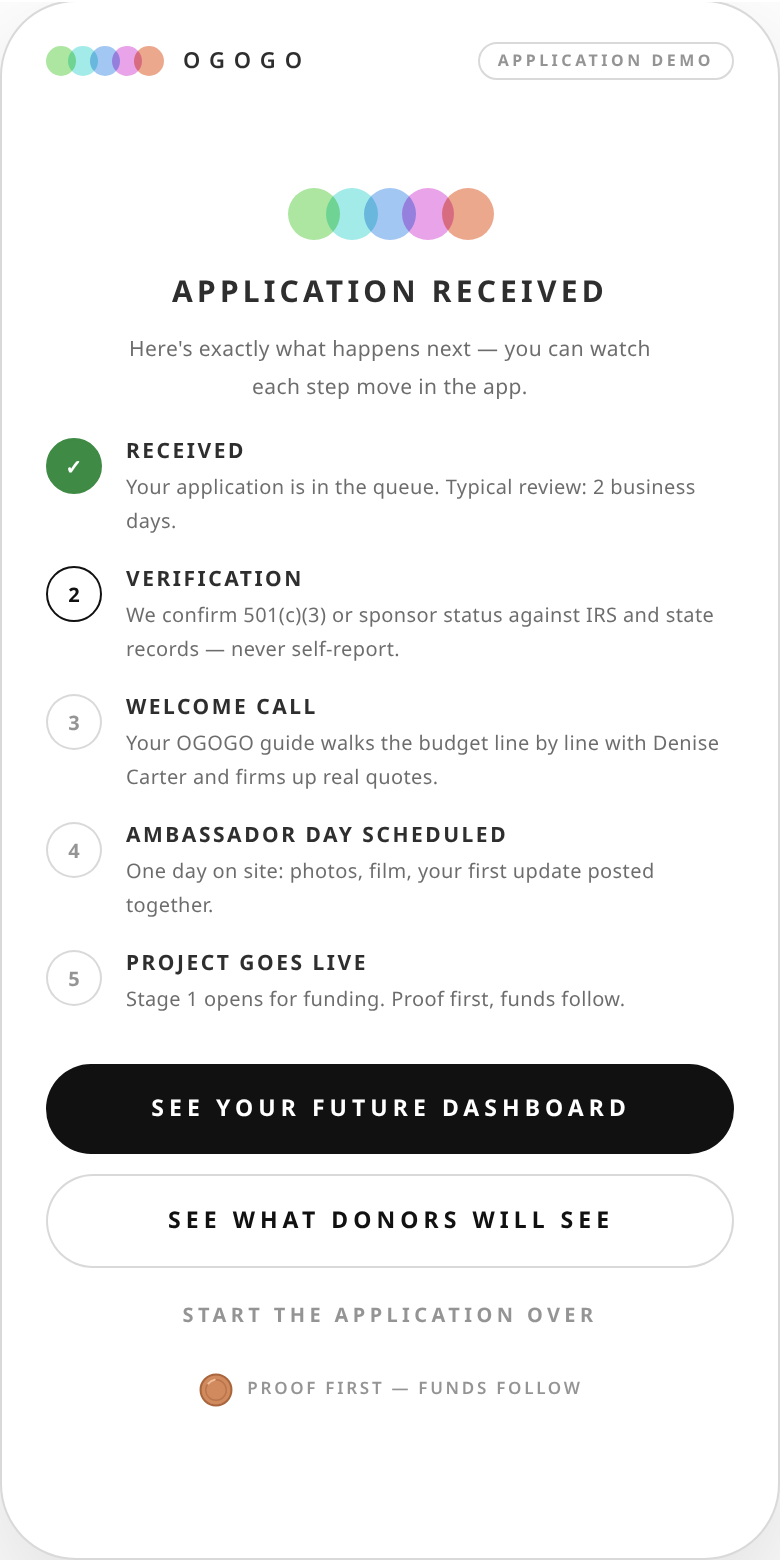
From application to live in five steps
Received → verification against IRS/state records → welcome call to firm up the budget → ambassador day on site → project goes live. Every applicant watches each step move in the app.
Ambassador day produces launch-quality photo and film for every project — content acquisition and vetting in a single site visit.
HOW EVERYTHING CONNECTS
TWO APPS, ONE LEDGER, ONE VERIFICATION CORE — EVERY ARROW ABOVE IS A SCENE YOU JUST WATCHED
THAT’S THE LOOP.
Record giving, collapsing trust, and no infrastructure connecting one donor’s dollar to its verified spend — until now. The demos below are live; the full investor deck (market history, competitive atlas, business model, roadmap) is emailed on request.